NAIROBI, Kenya, May 13 — Veteran cardiologist Dan Gikonyo came under sustained pressure in court on Wednesday as lawyers in the impeachment case involving former Deputy President Rigathi Gachagua challenged inconsistencies in his affidavit and questioned discrepancies in hospital timelines.
Lawyers representing the government side also probed why key medical records were only being formally introduced nearly one and a half years after the events at the center of the dispute.
The testimony unfolded before a three-judge High Court bench comprising Justices Eric Ogola, Anthony Mrima and Freidah Mugambi — the same panel Gachagua unsuccessfully sought to recuse from hearing petitions arising from his October 2024 impeachment.
The proceedings form part of the broader legal battle triggered after Parliament removed Gachagua from office in the country’s first successful impeachment of a sitting Deputy President, paving the way for the appointment of Kithure Kindiki.
The dispute escalated through multiple courts, culminating in a January ruling by the Supreme Court of Kenya declining to halt proceedings before the Ogola-led bench.
READ: Supreme Court rejects Gachagua’s bid to block impeachment case before Ogola bench
In a unanimous judgment delivered by Chief Justice Martha Koome, Deputy Chief Justice Philomena Mwilu and Justices Smokin Wanjala, Njoki Ndung’u and Isaac Lenaola, the apex court ruled that it lacked jurisdiction to interfere with ongoing High Court proceedings.
Conflicting timelines
Appearing before the Ogola-led bench, Dr Gikonyo defended the circumstances surrounding Gachagua’s hospitalization at Karen Hospital on October 17, 2024, after the former Deputy President allegedly complained of chest pain.
The cardiologist, who told the court he has treated Gachagua since July 2006, adopted a 12-paragraph affidavit sworn on April 28, 2026, as his evidence.
However, the hearing quickly shifted from medical explanations to disputes over documentary inconsistencies.
A major point of contention emerged over the timeline of Gachagua’s admission to hospital.
In his affidavit, Dr Gikonyo referred to seeing Gachagua at approximately 3pm or 3:25pm on October 17, 2024. However, a discharge summary attached to the affidavit indicated an admission time of 4:18pm.
Dr Gikonyo referred to seeing Gachagua at approximately 3pm or 3:25pm on October 17, 2024/CFM
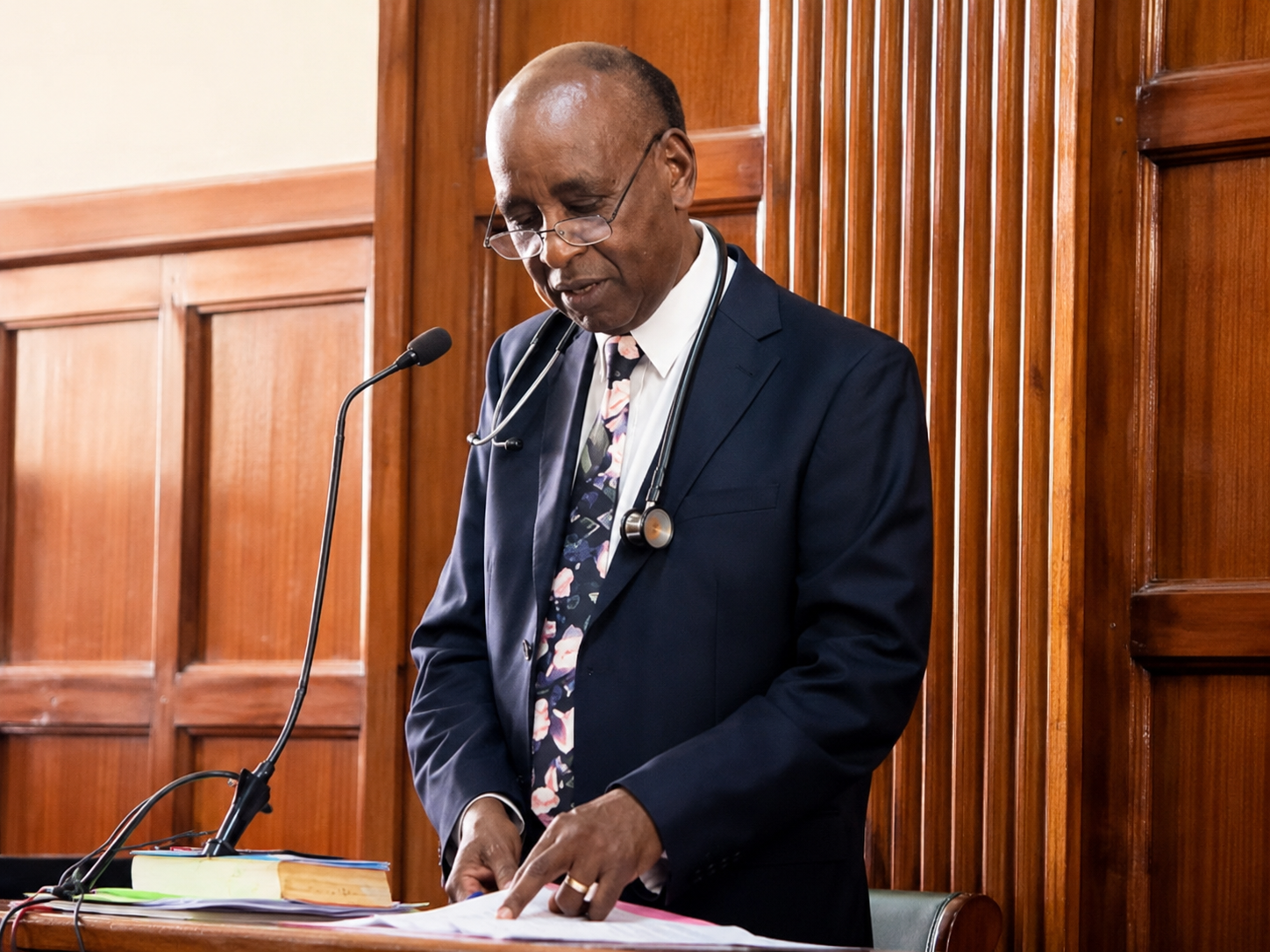
Pressed repeatedly by lawyers for the respondents, the cardiologist attempted to distinguish between the time the patient arrived at hospital and the time formal admission procedures were completed.
“The discrepancy is because as one comes to hospital, that is not admission,” Dr Gikonyo told the court.
“Admission is where the technical details are entered in the admission papers.”
The explanation immediately triggered objections from counsel representing the respondents, who argued the witness was improperly attempting to interpret or expand documents beyond what was expressly contained in the affidavit.
Oral variations contested
At one point, lawyers objected after the doctor referred to handwritten notes that had not been attached to the sworn affidavit.
“My Lord, now the witness is confirming why you are hearing objections,” one lawyer argued.
“The witness is referring to his handwritten notes, which are not attached to the affidavit.”
The courtroom exchanges grew increasingly tense as counsel repeatedly insisted the cardiologist could not orally “add to, subtract from, contradict or vary” documentary evidence already before the court.
One lawyer argued that if a matter was contained in a document, oral testimony could not subsequently be used to reinterpret it.
Despite the objections, the bench allowed Dr Gikonyo limited room to explain technical medical and administrative processes as an expert witness.
Justice Ogola observed that the court had to recognize the nature of expert evidence.
“We must understand that we have an expert witness,” the judge remarked.
“He has come to tell us something we may not know.”
Under cross-examination, Dr Gikonyo acknowledged the affidavit had been sworn nearly one and a half years after the hospitalization events being contested.
“You will agree with me, sir, this affidavit has been made one and a half years after the events described in it,” counsel put to him.
“Correct,” the doctor responded.
No records before Senate
Lawyers then questioned why the affidavit and attached medical records had not been presented earlier during the Senate impeachment proceedings.
The cardiologist acknowledged the records existed at the time but distanced himself from legal questions surrounding their delayed production.
“I don’t know the proceedings in court for those issues,” he said.
Counsel further pressed him on whether the differing timestamps amounted to a discrepancy “on its face.”
Dr Gikonyo resisted that characterization, insisting the entries referred to different events within the admission process.
“There are different occurrences. They are not the same thing we are describing,” he testified.
The cardiologist also revealed that President William Ruto personally contacted him during Gachagua’s hospitalization to inquire about the former Deputy President’s condition.
According to Dr Gikonyo, he only provided limited information after obtaining the patient’s consent.
Throughout the hearing, the court was repeatedly forced to intervene as legal teams battled over the permissible scope of examination-in-chief and expert testimony.
Lawyers for the respondents argued that attempts to clarify timelines and procedures amounted to an effort to repair inconsistencies in the record, while Gachagua’s legal team maintained the cardiologist was merely providing professional context necessary for the court to understand the medical documents.
The testimony now forms part of the wider impeachment litigation that continues to test constitutional questions surrounding parliamentary impeachment powers, judicial empanelment, recusal standards and the legal consequences of Gachagua’s removal from office ahead of the 2027 political cycle.